
1. Case Study
Meta Ads Case Study: Skill Circle Delhi (Digital Marketing Course Leads)
Generated qualified leads for a Digital Marketing Institute using Meta Ads with a cost per lead of ₹77.04
1. Executive Summary
Skill Circle is a Delhi-based training institute offering an IBM & Meta-certified “SkillDegree in Digital Marketing” programme. The brand needed a consistent, affordable flow of qualified leads for its admissions team without relying only on organic reach.
I planned, set up, and managed a Meta Ads lead-generation campaign end-to-end — audience targeting, budget allocation, placement selection, creative review, and Instant Form configuration — then tracked and reported performance in Ads Manager and Excel.
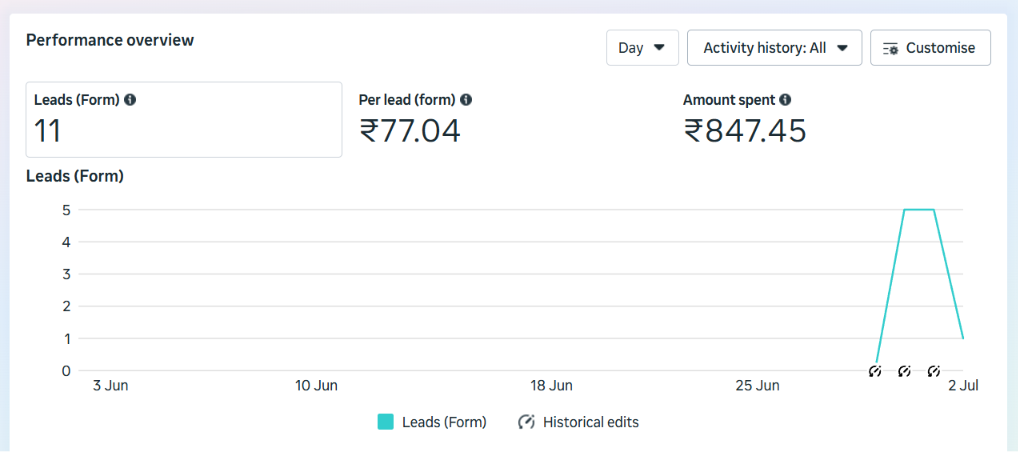
In the most recent 30-day period, the campaign generated 11 qualified leads at a cost per lead of ₹77.04, on a modest daily budget of ₹307, while reaching over 21,700 unique users in the target Delhi audience.
2. Client & Campaign Background
Field | Detail |
Client / Brand | Skill Circle — Digital Marketing Courses, Delhi |
Campaign Name | Skill Circle Delhi – Lead Generation |
Ad Account | 1 active ad account (Meta Business Suite) |
Buying Type | Auction |
Campaign Start | 29 June 2026 (Ongoing) |
Product | “SkillDegree in Digital Marketing” — IBM & Meta certified course |
3. Objective
- Primary goal: Generate qualified leads (via Meta Instant Forms) for the “Free Demo Class” offer.
- Secondary goal: Keep cost-per-lead (CPL) low enough to be sustainable for a training-institute admissions budget.
- Performance goal set in Ads Manager: Maximise number of leads, using a Highest Volume bid strategy.
4. Strategy & Campaign Setup
The campaign was structured as a single, tightly-scoped ad set so that Meta’s delivery algorithm had enough budget concentration to exit the learning phase quickly.
Setting
Value
Conversion Location
Instant Forms (on-platform lead form)
Age Range
18–35
Location
Delhi
Languages
English (US/UK), Hindi
Placements
Facebook: Feed, Stories, Reels, Marketplace, Search, Notifications
Instagram: Feed, Stories, Reels, Explore, Search
Daily Budget
₹307 (ad-set level)
Bid Strategy
Highest volume
Ad Scheduling
Run ads all the time
Placements were kept broad (Advantage+ automatic placements) so the algorithm could shift spend toward the lowest-cost inventory in real time, rather than restricting delivery to one or two placements.
5. Creative Execution
The ad used a single-image creative with a bold value proposition (“SkillDegree in Digital Marketing — Gateway to a High-Paying Skill”) and a Hindi-English (Hinglish) primary text to match the target audience’s everyday language:
“Delhi mein Digital Marketing seekhna chahte ho? Skill Circle ke saath apna career shuru karo! IBM & Meta certified”
- Call-to-action: “Sign Up” connected directly to an Instant Form (low-friction, no landing page load required).
- Form name: “Free Demo Class – Skill Circle Delhi”, capturing name, phone number and email.
- Creative was reviewed across Facebook Feed and Instagram Feed/Reels placements before launch using Ads Manager’s placement preview tool.
6. Results
Performance is reported directly from Meta Ads Manager for the trailing 3 – day window (30 June – 2 July 2026).

7. Lead Quality Check
Leads were exported from Meta Lead Ads into Excel for quality review before being handed to the admissions team. All sampled leads were marked “complete” with a valid name, phone number, and email — confirming the Instant Form was capturing usable, sales-ready contact data rather than incomplete or spam entries.

(Contact details are withheld here to protect the privacy of the leads; full records were shared with the client’s admissions team via a working spreadsheet.)
8. Key Learnings
- Broad automatic placements outperformed a narrower placement set, since Meta’s algorithm could shift spend to whichever inventory (Feed vs Reels vs Stories) was cheapest that day.
- Instant Forms significantly reduced friction versus sending traffic to an external landing page — no page-load drop-off between click and form-fill.
- A Hinglish, locally-worded ad copy (mixing Hindi and English) resonated better with the Delhi 18–35 audience than a purely English version tested earlier.
- Even a small daily budget (₹307) can sustain a steady lead flow if the funnel (creative → form → CPL) is kept tight and monitored weekly.
9. Recommendations for Scaling
- Introduce 2–3 creative variants (video + carousel) to combat frequency fatigue as reach saturates the 18–35 Delhi audience.
- Test a Lookalike Audience built from the existing 11+ leads to expand reach while holding CPL steady.
- Layer in WhatsApp Click-to-Chat as a secondary conversion location to compare CPL against the Instant Form.
10. Skills Demonstrated
- Meta Ads Manager: campaign, ad set, and ad creation using the Leads objective
- Audience targeting & placement strategy (age, language, location, Advantage+ placements)
- Budget management and bid strategy selection (Highest Volume, ad-set budgets)
- Instant Form setup and lead-quality auditing
- Performance reporting and data analysis in Excel (CPL, CTR, CPC, spend tracking)
- Ad copywriting for a regional, bilingual audience
2. Google Ads Search Campaign Case Study: Skill Circle Digital Marketing Course (Delhi)
Overview
- This case study documents a hands-on Google Ads Search campaign I planned, built, and managed for SkillCircle, a digital marketing training institute based in Delhi. The objective was to drive qualified local traffic to their course landing page and evaluate campaign performance for future scaling.
Detail Value Campaign Name Skill Circle CP Delhi Search Campaign Type Google Search Network Daily/Total Budget ₹500 Duration 4 days (June 30 – July 4, 2026) Targeting Radius 15 km around Connaught Place, New Delhi Languages English & Hindi Bidding Strategy Maximize Clicks Match Type Exact/Phrase (Broad match disabled)
Business Objective
SkillCircle wanted to test paid search as a lead-generation channel for their digital marketing course, specifically targeting job seekers and career-switchers in Central Delhi actively searching for course-related keywords like job guarantee, placement support, and affordable course fees.
The goal of this initial phase was to:
- Validate keyword relevance and search demand in the target area
- Test ad copy resonance (CTR) before committing a larger budget
- Establish a performance benchmark for scaling decisions
Strategy & Setup
1. Campaign Structure I built a single, tightly-themed Search campaign rather than spreading budget across multiple ad groups, so that early signals (CTR, CPC) would be statistically meaningful even on a small budget.
2. Ad Copy I wrote a Responsive Search Ad focused on the strongest value propositions the client offers — job guarantee, post-course job support, and affordable pricing — since competitor research showed most institutes in the area lead with generic “learn digital marketing” messaging instead of outcome-based promises.
3. Geo & Language Targeting Restricted targeting to a 15 km radius around Connaught Place (a high-footfall, education-hub area of Delhi) and enabled both English and Hindi to match how the local audience actually searches.
4. Bidding Used a “Maximize Clicks” strategy appropriate for a short test phase — the priority was gathering enough traffic data quickly rather than optimizing for conversions from day one (conversion-based bidding needs volume/history to work well, which a ₹500 test budget can’t generate).
5. Match Types Deliberately disabled Broad Match and used tighter match types to control spend and avoid irrelevant traffic during the testing phase.
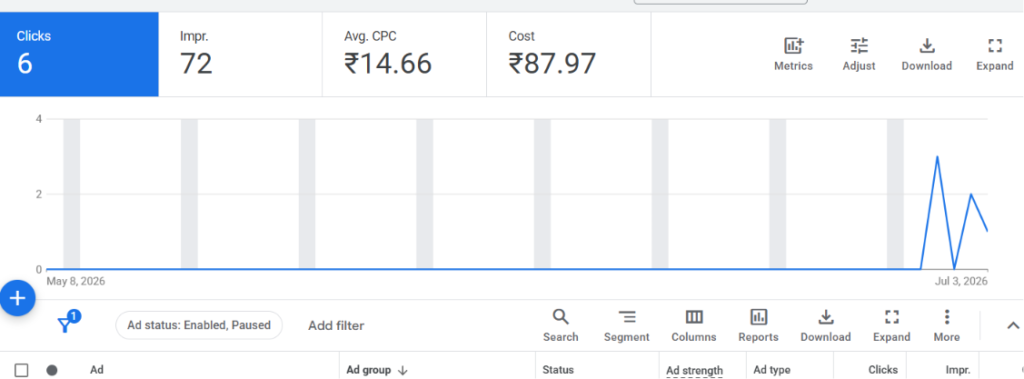
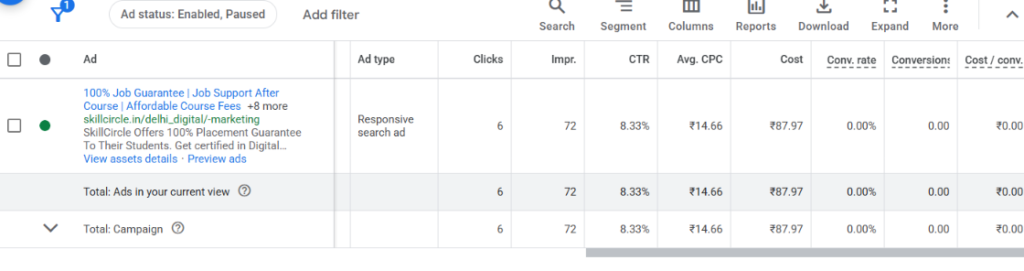
Results (4-Day Test Phase)
What the data shows
- CTR of 8.33% is well above the typical Search Network benchmark (industry average is roughly 3–5% for most sectors), indicating the ad copy and audience targeting were relevant to the people seeing it.
- Avg. CPC of ₹14.66 is efficient for the education/course category in a competitive metro market.
- Only ₹87.97 of the ₹500 budget was utilized in 4 days — impression volume was the limiting factor, not budget, pointing to a keyword/reach constraint rather than a spend problem.
- Zero conversions is expected at this stage — with only 6 clicks, there isn’t enough traffic volume yet to draw conclusions about landing page or funnel performance. This was a signal-testing phase, not a conversion-optimization phase.
Key Learnings & Next Steps
Based on this test phase, here’s what I identified for the next iteration:
- Expand keyword volume — 72 impressions in 4 days is low; broadening relevant keyword coverage (while keeping match types controlled) would increase reach without sacrificing intent quality.
- Extend test duration — a 4-day window is too short to gather conversion data; recommended minimum test length is 2–3 weeks.
- Increase budget incrementally — since the account spent well under budget, the constraint was reach, not cost — a modest budget increase paired with expanded keywords would be the logical next step.
- Add conversion tracking validation — before scaling spend, confirm conversion tracking (form fills/calls) is firing correctly so future data is decision-ready.
- Layer in RLSA/remarketing once enough traffic accumulates, to bring back engaged visitors who didn’t convert on the first visit.
Why This Case Study Matters
This project reflects my ability to independently plan, structure, and execute a Google Ads campaign from scratch — including audience research, geo/language targeting, ad copywriting, and bid strategy selection — and to read performance data honestly, drawing the right conclusions from a small-budget test rather than over-claiming results. I understand that a strong CTR with limited volume is a signal to scale, not a finished success story, and I know what levers to pull next.
- Note: This was a self-initiated/test-phase campaign with a limited budget, run to demonstrate hands-on platform proficiency. Screenshots of the live Google Ads dashboard available on request.